


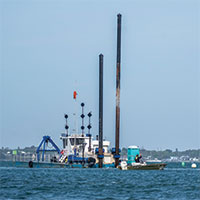
 Mishaps plague Sebastian Inlet dredging project
STORY BY JON PINE (Week of April 9, 2026)
The much beleaguered, long overdue dredging project at the Sebastian Inlet has been hit with yet another in a troubling series of mishaps and missteps, delaying completion of the project by another two months – putting the project more than a year behind schedule and adding to $1.3 million in cost overruns.
Work on the project began Jan. 6, 2025, and was supposed to wrap up four months later, on April 30. This latest delay extends the deadline to May 30 of this year.
The new setback is being blamed on bad weather. Strong surf churned up by stormy weather in early February eroded about 5 feet of an already narrow beachfront about 1,500 feet south of the inlet, dislodging a long section of flexible pipe that carries dredged material to the beach, according to James Gray, executive director of the Sebastian Inlet District, the independent special taxing district that maintains the inlet.
Faced with this system breakdown, inlet district commissioners on Feb. 11 gave dredge contractor ATL Diversified Industries two more months and paid an additional $48,313 to rebuild the beach and sink 20-foot pilings in the sand to anchor 1,170 feet of pipe to keep it from being dislodged by future erosion.
Commissioners also paid an additional $50,625 to AtkinsRéalis, the Canadian-based engineering firm overseeing the project, to continue its oversight through May 30.
Problems have plagued the project since shortly after work began last January, according to district officials and project documents. ATL, the only bidder on the huge sand relocation job, was awarded the contract at a cost of $7,253,300. But delays and mishaps have since cost district taxpayers an additional $1,249,418, bringing the current total to $8,502,718.
The inlet dredging process is called “bypassing” and is necessary every four or five years. Sand and other material that has accumulated in the inlet is vacuumed up under high pressure using flexible pipes made of high-density polyethylene and deposited either into a holding area north of the inlet or directly onto the beach south of the inlet.
The main goal is to clear the channel for the boats that swarm in and out of the inlet. A secondary goal is to renourish the beach south of the inlet that is sand-starved because the inlet’s long stone jetties block the natural movement of sand down the coast, from north to south.
The project got off to a rough start when ATL discovered that the wrong size pipe had been delivered, Gray said. Work was at a standstill until the correct size arrived at the job site.
Shortly after the new pipe arrived and dredging began, a fire broke out on a dredge platform, Gray said, prompting another delay while crews waited for a mechanic to be flown in from California to repair the equipment.
Following that unexplained fire, in late March, at least three boats struck dredging pipe floating in the channel near the surface, Gray said. While it is customary in the marine construction industry to anchor dredge pipes at the bottom of a body of water, ATL did not do that, he said. ATL also had difficulty keeping the pipes submerged due to stronger than usual tides in the inlet, he added.
Black pipe floating near the surface is difficult for boaters to see, and ATL acknowledged they should have done a better job of marking the area with caution signs to notify boaters of the pipe’s location, according to Gray.
Nobody was hurt in the boat strikes, Gray said, adding that he believes ATL’s insurance carrier is covering any damages.
Work stopped again while ATL anchored the pipe and improved caution signage. ATL also notified boating and fishing groups to use extra caution near dredging equipment. Since then, no boat strikes have been reported, Gray said.
By then, commissioners began to worry that ATL would not be able to finish the project, and on April 9, 2025, they voted to extend the April 30 deadline to May 30, 2025. Commissioners also asked Shawn Demers, the district’s attorney, to notify ATL in writing about their concerns, according to district documents.
By early May, it was clear that ATL would not make the new deadline, and in fact would only complete about 60 percent of the project by the end of the month, Gray said.
On May 14, 2025, commissioners extended the contract deadline again, this time to June 11, 2025, not so ATL could continue dredging, but to give them time to come up with a solution for finishing the project, documents say.
Over the next several months, Demers and Rossway Swan, ATL’s attorney, hammered out an agreement in which ATL would be paid $650,000 to “remobilize” and complete the project in the 2025-2026 dredging season. Commissioners approved the agreement in September, and ATL returned to work soon after, Gray said.
On Nov. 5, 2025, Gray authorized an additional payment of $6,600 to ATL so they could clear sediment from equipment in the Dredged Material Management Area (DMMA), a 6-acre site north of the inlet where dredging material that is not suitable for the beach is kept.
Vero Beach 32963 asked Gray if district taxpayers would be correct in arguing that ATL was responsible for most of the delays and should have borne some or all of the added expenses, or that it would have been wiser to choose another contractor to finish the work.
Gray responded, “This is a big project and there are many components. Ultimately, contractors are responsible for completing projects as bid and the district does not direct construction means and methods. In some cases, unanticipated delays, such as weather, equipment failures, scheduling, environment, etc. do occur on larger projects that require reasonable project extensions.”
The delay and expense caused by damage from the February storms was a force majeure – the legal term for an unforeseen event beyond ATL’s control, he said.
“The district worked with ATL to determine a reasonable way to complete the entire project without rebidding and/or pursuing their construction bond. Offering ATL the opportunity to remobilize and complete the project supported the district’s goal to complete the project.”
Even with all the problems and delays, the project duration still fits within the timeframe of the state and federal environmental permits for the project, according to Gray.
ATL has completed phase 1 of the project, which was to truck in 90,000 cubic yards of beach-compatible sand to rebuild beaches in sector 2, a mile south of the inlet. Phases 2 and 3, dredging the 150-foot-wide channel to a depth of around 10.5 feet, is also complete. That material was deposited in the sand storage area.
By the end of March, ATL will have completed about 50 percent of phase 4, the final phase, which calls for dredging the 42-acre sand trap in the inlet to a depth of around 17 feet. Most of that sand is being pumped directly onto sector 1 beaches, immediately south of the inlet.
Beach sectors 1 and 2 together stretch from the inlet south to the McLarty Treasure Museum. Replacing the sand is a requirement of a Memorandum of Understanding (MOU) with Indian River County that requires the inlet district to make up for sand lost due to bypassing.
An MOU is a nonbinding document outlining an agreement between two parties. About 150,000 cubic yards of sand typically are placed on sector 1 and 2 beaches during each dredging project. ATL is on track to distribute at least that much beach-compatible sand on the starved beaches, Gray said.
Even with the added costs, the project qualifies for matching grants from the Florida Department of Environmental Protection’s Beach Management Funding Assistance Program, which will reimburse the district for at least 50 percent of the project’s final costs, Gray said.
The district schedules its dredging projects in winter to avoid sea turtle nesting season, which runs from March 1 to Oct. 31. But dredging impacting beaches south of inlet continued well into turtle nesting season last year and this year. Barring any unforeseen bad weather or mishaps, Gray is confident ATL will complete the project by the new deadline of May 30.
The state environmental permit for this project prohibits construction on the beach beyond April 30, but ATL can continue working in the channel area through May, he said. Marine scientists with Ecological Associates, Inc. have been monitoring the beaches every morning. If they spot fresh turtle nests, they cordon them off and notify workers to keep clear, he said.
If for some reason ATL doesn’t finish dredging the sand trap by May 30, completion of that phase of the project may have to wait until the next dredging project is scheduled four or five years from now, Gray said.
However, construction of the new $111.7 million SR A1A bridge over the inlet is scheduled to begin this spring, concluding in the fall of 2031, which may butt up against the timeframe for the next dredging project, he said.
“We are aware of the bridge project may impede on the next dredging project as well as our jetty rehabilitation project, we’re just not sure how much,” Gray said.