


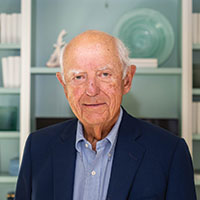
 How an unlikely entrepreneur founded a billion-dollar real estate company here
STORY BY STEVEN M. THOMAS (Week of February 26, 2025)
In a challenging year for real estate, in which aftershocks of the pandemic real estate boom were still reverberating and interest rates and affordability were grit in the industry’s gears, Dale Sorensen Real Estate’s 225 agents sold more than a billion dollars’ worth of houses, condos and land – for the sixth year in a row, according to the company.
The details of this accomplishment are highlighted in the company’s just-issued 2025 Annual Report – the first written annual report Sorensen has put out in nearly 50 years in business.
The 10-page brochure is interesting reading for anyone involved in real estate on the barrier island or Indian River County as a whole, but it leaves a big question unanswered.
How did this happen?
How did a homegrown Vero Beach company started by an ex-schoolteacher embarking on his third career at age 38 become a consistent billion-dollar operation in a tiny market in a city once known as Zero Beach?
Certainly, it would have been hard to predict the company’s success when Dale Sorensen Sr. hung out his shingle at a cramped office on Beachland Boulevard in 1978.
Not far from his 40th birthday, Sorensen was an unlikely entrepreneur. He came from a strictly working-class background in Staten Island, New York. Neither of his parents were entrepreneurial and he studied history, not business, when he went away to college on an athletic scholarship.
He started his working life as a parochial schoolteacher, which doesn’t scream IPO, and then worked for Gulf & Western Corporation, where he did well but was still just a cog in a massive, diversified conglomerate, with layers of decision-makers above him.
A soft-spoken man who says he has never talked much throughout his 80-plus years, preferring to listen and learn, Sorensen had no experience selling residential real estate, and Vero Beach was anything but booming. The city’s population was around 16,000, not much different from today, and there were only 50,000 people in the entire county.
And yet the company took root and grew along with the community, becoming the largest real estate brokerage in the county and hitting a billion in sales for the first time early in the decade.
So, the entrepreneurial DNA was there. But where did it come from?
In a long interview in his office, Sorensen told Vero Beach 32963 that it was programed into him along the way by a diverse and colorful series of mentors, ranging from an Episcopal priest to a Texas oil man to a division chief at a Fortune 500 corporation.
“I was working at St. Andrew’s School in Boca Raton, and the person who started that school, Father Hunter Wyatt-Brown, wanted to start another independent Episcopal school in Vero Beach. That was in 1964. He asked for volunteers and I agreed to come along and help him, and I would have to say, that is when I began to learn a little bit about entrepreneurship, about building something.”
Working with Wyatt-Brown, who Sorensen describes as an inspirational, visionary leader, and local backers of the embryonic St. Edward’s School, the 25-year-old schoolteacher learned about capital costs, revenue streams and how to build an organization. Besides the enterprising priest, many of the backers were successful entrepreneurs themselves, who had started small, bought land, and become big citrus growers.
Sorensen’s education was amplified when the board tapped him as interim headmaster of the tiny school under emergency circumstances when it faltered during its first year, and he had to plunge into a fundraising endeavor to rescue St. Ed’s.
He grew into the role of official headmaster over the next five years or so, learning more about hiring, organizational development and managing money as the school found its footing and became an essential part of Vero Beach.
During that period, a highly entrepreneurial relative of his named Alton Nance came to town regularly and intentionally mentored him.
“He was a very wealthy person,” Sorensen said. “He made a lot of money in the oil business in Texas, but his hobby at that point was going around the country fixing broken companies. That's what he liked to do.
“Every time he was here, he would sit me down and teach me about problem-solving, structure and organization. He taught me an incredible amount.
“He drilled into me that whatever I did in the future, I had to do it on a very, very sturdy and firm foundation, and he also instilled in me that if you want to have a successful business, you must give back to the community where you make your livelihood.”
By 1969, Sorensen was feeling the itch to do more that is common to incipient entrepreneurs. While remaining on St. Edward’s board, he left his headmaster position and took a job with Gulf & Western, where he met perhaps his most important mentor.
Alvaro Carta had fled Communist Cuba to live in Miami in 1960. By the late 1960s he was running a sugar company in the Dominican Republic, a situation he leveraged to create a new “food division” at Gulf & Western.
He hired Sorensen in 1969 as his right-hand man at a time when the far-flung division was operating the second-largest sugar mill in Florida and the largest sugar mill in the world in Romana, in the Dominican Republic.
“I was fortunate that he took me under his wing,” said Sorensen. “I spent a lot of time with him, both in the Dominican Republic and going to New York, to the parent company, for meetings, sitting in with him while he negotiated deals and dealt with problems. I got a doctor’s degree in business, if you will, just by being with him.”
Sorensen spent nine years with Carta and Gulf & Western, from June 1969 to May 1978, eventually taking the lead in developing the famous Casa de Campo luxury resort in La Romana, near the sugar mill.
Putting together that sprawling resort – which occupies 7,000 acres, with three golf courses, hotels, villas, a beach club and 5 miles of Caribbean coastline – was Sorensen’s post-grad training.
Along with high-level business experience, Sorensen also found his wife and business partner, Matilde Sorensen, in the Dominican. They were married in 1972, settled in Vero Beach, and had two children, Dale Sorensen Jr. and Elizabeth Sorensen, who play important roles in the company today.
In 1978, Gulf & Western downsized its food and resort division and Carta moved division headquarters from Vero Beach to Palm Beach.
“I didn’t see much future at that point,” Sorensen said.
The New York office offered him a job elsewhere in the organization, but he and Matilde didn’t want to leave Vero Beach.
Sorensen was known around town as a board member and the former headmaster of St. Edward’s School, he was on the hospital board and had some solid business experience by then but was still unsure of his next step when Matilde’s father, Jorge Garip, a successful businessman, came to town for a visit.
“He took me aside one day and told me, ‘Dale, I’ve observed you, and you work very hard, six or seven days a week, and you’re obviously well thought of within the organization. But tell me, do you really want to wake up 25 or 30 years from now and somebody gives you a handshake and a gold watch and a pat on the back as you walk out the door? On the other hand, what would happen if you put all that energy and effort into working for yourself?’”
“So, I thought a lot about that, and I told Gulf & Western no, and opened Dale Sorenson Real Estate in 1978,” Sorensen said.
A two-year consulting contract with Gulf & Western helped with the transition and Sorensen said the top real estate brokers in Vero at that time “who could have buried me,” instead extended helping hands.
“Ed Schlitt, Alex MacWilliam, Cliff Norris and Ron Rathbun – each of those men helped me tremendously,” he said.
But the biggest boost came in 1981, when Matilde Sorensen got her real estate license and joined the firm as an agent.
“That was the best thing that ever happened to the company,” Sorensen said with a smile. “One of the things that attracted me to Matilde to begin with was her entrepreneurial spirit and energy – and you can see what happened.”
Besides becoming the top-selling real estate agent on the island for many years running, Matilde brought another whole stream of entrepreneurship into the family business.
“Her father was very entrepreneurial,” Sorensen said. “He owned at least one radio station in the Dominican Republic, he owned a cattle ranch, he was in the dairy business, and while he wasn’t an elected official, he was an influential person within the government.
“His family, Matilde’s grandparents, were entrepreneurs, too, merchants and real estate investors who always bought all the commercial property they could, especially corner lots! If you go to Romana today, I think you will find they still own one of the most prominent corners in town.”
That DNA showed up in Dale Jr., who led the company’s expansion into Brevard County and is managing partner, and Elizabeth, who has followed in her mother’s footsteps as a highly successful agent, selling more than $50 million last year.
Along with acquired entrepreneurship, Dale Sorensen Sr. said his success is due most fundamentally to the values of hard work and right effort instilled by his parents in Staten Island.
“Both my parents’ families were basically poor working families, and both of them had to leave school before finishing the sixth grade to help support their families,” he said. “My mother's father had a stroke and was incapacitated, so she had to leave, and my father had five or six siblings, and he was the oldest and so his parents needed him work.
“My mother was a waitress her whole life, working double shifts to support our family. My father started out as a handy boy in the shipyards and worked his way up to be a tugboat captain,” Sorensen said. “If there was a strike, he would work two jobs to make ends meet, driving a taxi, or whatever.
“They bought the only house they ever owned for $4,500 in 1944, and it took them 29 years to pay off the mortgage. They taught me to work hard and always do my best,” Sorensen said.
That advice might sound cliched, but it seems to have worked.
Sorensen said 2026 is off to a strong start for his company and he expects another billion-dollar year in 2027.
“I don’t know if you can use the word normal anymore, but let’s say the market is stable. Barring any big financial or global catastrophe, I think it should be a good year.”