


 Marsh Island emerges as a rare waterfront bargain
STORY BY STEVEN M. THOMAS (Week of January 8, 2025)
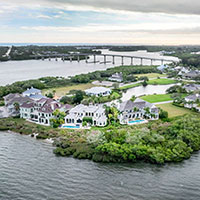
Vero Beach buyers are finally waking up to the virtues – and value – of Marsh Island, the gated club community with a picturesque harbor that can be seen north of the Wabasso Bridge when crossing from the barrier island to the mainland.
A record-breaking sale closed in December for $3,865,000, a whopping 60 percent higher than any previous sale, and three new homes are underway, in various stages of preconstruction or construction, according to Susan Von Hagen, who has lived in the community for 15 years and is a member of the architectural review committee.
Despite the burst of activity, property remains much more affordable than in similar 32963 waterfront communities, according to ONE Sotheby’s agent Richard Boga, who sold the record-price home with his business partner, Cindy O’Dare.
“Even though the closing price was the highest ever for Marsh Island, the house was still a screaming bargain,” says Boga. “The same house on the water in John’s Island would be $10 million or more, $8 million in Riomar, and at least $6 million in The Moorings.”
The 5,800-square-foot home, located at 9275 W. Marsh Island Dr., sits on a .30-acre waterside lot, has four bedrooms, three and half bathrooms, and was designed by highly regarded Vero Beach architect Mark Vigneault.
Waterfront lots are inexpensive, too. There are three on the market, ranging in price from $510,000 to $775,000, much cheaper than in other club communities elsewhere in 32963. The least expensive lot sits right on the charming harbor, with room for a 3,500-square-foot house with a cabana and courtyard pool.
O’Dare and Boga say property is undervalued because the community got off to a rocky start, with a period of foreign ownership and a series of development problems that soured realtors on the neighborhood and cast a negative aura that stubbornly persists today.
“Vero Beach realtors have not been bullish on Marsh Island,” says O’Dare. “We’ve had several listings in there and very few local realtors asked to show any of the homes. For some reason, the rumor mill continues to be very negative about the community, even though it’s a beautiful, well-run club with a top-notch marina.”
Von Hagen says, “the developer had some dealings with the local realtors that created bad feelings back in the early 2000s, when the community first opened for sale. When my husband and I were looking for a home in Vero, none of the realtors ever mentioned Marsh Island. We saw it coming across the bridge and checked into it ourselves.
“It was an, ‘Oh gosh, this is what we have been looking for’ moment. Some of my neighbors say the same thing. Their realtors didn’t show them property here. They found it on their own.
“I can’t tell you how many lunches and events I’ve been to where people say there’s supposed to be something wrong with Marsh Island, that it’s sinking or it floods or there are bugs, and all kinds of weird, odd stories.
“None of it’s true.”
County historian Ruth Stanbridge says Marsh Island started, as its name hints, as a marshy mangrove Island.
“It was filled with dredge spoil in the late 1950s or early 1960s when they came through repairing the intercoastal, which had silted in during and after World War II,” says Stanbridge. “That was the same time they filled the area where the Environmental Learning Center is, Riverside Park, where the museum sits today, and other wetland areas along the lagoon.”
When new land was created by filling wetlands, it became the property of the state in most cases, according to Stanbridge. The state then had the ability to sell the land to municipalities or developers.
County records don’t show who originally bought Marsh Island, but it was developed, starting in 2000, by Marsh Island Development Company. The first house was completed in 2004, with half a dozen more finished between 2005 and 2007.
The 2007 real estate crash brought development to a halt as in hundreds of other new communities across the country. Some of the builders putting up spec homes lost millions and most of the lots sat fallow for a number of years.
One partly finished home clearly visible from the bridge became a notorious eyesore. The owners of the home at 9250 E. Marsh Island Dr. ran out of money in 2007 and the three-story house moldered away for more than four years, during bank proceedings and other legal activity. County building officials eventually condemned the abandoned structure, and it was torn down in 2011, but by then it had further damaged the community’s reputation.
When Von Hagen and her husband John Von Hagen arrived in 2010, John Von Hagen became president of the small HOA, helping facilitate demolition of the eyesore.
The community has been on a slow rebound ever since, with prices gradually creeping up. Pre-covid home sales were in the $1.7 million range. By 2024, the top sale was $2.4 million, which was eclipsed in 2025 by O’Dare and Boga’s $3.8-million transaction.
Despite lingering doubts about the community, a recent visit found that it is indeed a well-designed, well-kept luxury enclave, which has in the words of one visitor “a fairytale feeling.”
Past the elegant gate, a curving entry drive leads through manicured landscaping to a beautifully designed and decorated West Indies-style clubhouse that’s reminiscent of the clubhouse at Lyford Cay in the Bahamas.
The elegant West Indies style is maintained throughout the community by the architectural review committee, so that the island does not become a hodgepodge of discordant styles, which sometimes happens when development drags out in a subdivision.
Houses around the perimeter of the island have to be 4,500 square feet or larger by code, though Von Hagen says there is a “tiny bit of flexibility.” Homes around the marina must be at least 3,500 square feet.
Existing houses range from 3,500 square feet to over 9,000, according to county records, with the largest homes on the island’s north-facing point.
“The views are to die for,” says Von Hagen, whose home is on the point. “You are looking down at Pelican Island [National Wildlife Refuge]. I see dolphins and manatees every day, and if you like boats, you have it made. This time of year, you see all the gorgeous yachts going down the Intracoastal Waterway to Fort Lauderdale and Miami. Then in the spring you see them heading back north. It is incredible on a windy day.”
The marina is shipshape, with a full-time marina manager and no sagging docks. A broad concrete walkway bordered by a neatly trimmed hedge on the land side sits atop the seawall that surrounds the harbor.
“It is a great hurricane hole,” says harbormaster David Tate, who has been managing the marina for the past 15 years. “It’s shielded from wind and waves and there isn’t much tidal surge. Larger boats typically stay in the water during storms.”
Known as Marsh Island Yacht Club, the marina is a separate condominium association, so homeowners who do not have boats don’t bear any expense for the amenity.
There are 32 slips, many owned by Marsh Island residents, others by boaters in other communities. “A lot of Windsor people have boats here,” Tate says.
The marina, which provides fuel service, can accommodate a 90-foot boat, according to Tate, though most slips are 65 feet or smaller. A 58-foot slip recently sold for $200,000. For people who like to get out on the water frequently, nearby waterside dining in Sebastian and Vero Beach is a draw.
The marina also provides quick access to the Sebastian Inlet and Atlantic Ocean for sport fishermen or people headed for the Bahamas.
“It is wide open between here and the inlet, with no ‘no wake zones,’” Tate says.
Despite rumors of flooding, Tate says the most he has seen in 15 years is water lapping up over the concrete walkway. “We have never had any damage,” he adds.
Boga says homes are a minimum of 13 feet above the water level.
Marsh Island Club does not have a full slate of amenities, such as golf, tennis and pickleball, but Boga notes the community’s proximity to other clubs that accept outside members, including Grand Harbor Golf and Beach Club and Bent Pine Golf Club.
“Either of those clubs would be a nice addition to your lifestyle if you live in Marsh Harbor and want more activities,” Boga says.
“It is five minutes to Grand Harbor’s beach club and 15 minutes to the main club, with golf, racquets, dining and all the other amenities. You can also cruise to the main club in your boat if you want to get out on the water.”
Bent Pine, which just finished a $4-million golf course and clubhouse improvement project, is 15 minutes from Marsh Island, as is Sexton Plaza in Central Beach.
A shopping center going in at DiVosta’s Harbor Isle subdivision will put a brand-new Publix and other shops five minutes away from Marsh Island, and Wabasso Beach Park, an ocean beach with lifeguards, is even closer.
When built out, there will be 32 homes in Marsh Island Club, including eight frontings on the harbor, four on interior, lakefront lots, and 20 exterior, shoreline houses.
“It’s not really a retirement community,” says Susan Von Hagen. “Our youngest resident is 3 years old and Chuck, who just sold his house, is 98. We have a lot of kids for a Vero Beach community. It is a magical place for them to grow up.
“I didn’t expect to like it as much as I do when we moved here. My husband and I take a walk around the island every day, looking at the dolphins, the birds and the boats in the marina. It is very private but close to things, and you are living right in the middle of nature.
“Honestly, for me, it is like being on permanent vacation. The only downside is when we don’t travel much. When the idea of a trip comes up, we look around at this place and say, ‘No, I don’t think so!”