


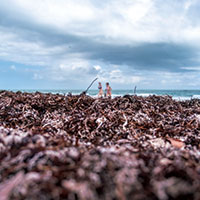
 Expert details how sargassum infestation poses potential threat to island ecosystems
STORY BY STEVEN CHAMBERS (Week of March 5, 2026)
Harbor Branch’s remarkable Ocean Science Lecture Series is in full swing, giving anyone who shows up an intimate, inside look at critical marine research being conducted just south of Vero Beach at the storied oceanographic institute on the shore of the Indian River Lagoon.
In February, an eye-opening lecture entitled “The Science of the Great Atlantic Sargassum Belt” was given at Harbor Branch by Brian Lapointe, Ph.D. Lapointe is probably the world’s leading expert on the brown seaweed Vero beachgoers have seen – and loudly complained about – during summer months along the shore from Jaycee Park to South Beach Park.
The tale he told is one of fundamental biological change in the oceans that has caused an almost unimaginable proliferation of sargassum in the Caribbean and South Florida, threatening local ecosystems and costing the tourism and fishing industries “billions of dollars along Florida’s Atlantic coast,” according to ScienceDirect.
So far, the nitrogen-driven profusion of seaweed – which stinks and emits harmful gases when it rots on beaches – has mostly stayed south of 32963, but the question is, for how long?
“The system has changed,” LaPointe told Vero Beach 32963. “For most of recorded history, Sargassum was largely confined to the Sargasso Sea and parts of the Gulf. What we’re seeing now is a new source region forming south of that area, fed by river discharge and altered nutrient chemistry. Once you change the nutrient balance in the ocean, biology responds.”
Today the seaweed empire extends from the Gulf of Mexico almost to Africa, inundating the Antilles and riding ocean currents to far-flung beaches from Mexico to Puerto Rico to Palm Beach.
Last year was a record year for sargassum in Southeast Florida, with seaweed covering half of the sand at Lantana Beach, according to WPTV reporter Joel Lopez, whose report, “‘It’s gross!’ Sargassum takes over Florida Beaches,” was published last July.
And this year is expected to surpass 2025, with 38 million metric tons – 84 billion pounds – of seaweed adrift in the Great Atlantic Sargassum Belt.
When offshoots of that floating mat reach Florida’s coast, the concern is not the seaweed itself, but what happens next, Lapointe said.
Within 24 hours of landing, it begins to decompose, releasing hydrogen sulfide and ammonia. The rotten egg smell is not harmful if only a small amount of sargassum comes ashore, as in Vero so far, but if “you have a huge amount of seaweed . . . it is very bad, it is toxic” for people breathing in the gases, Dr. Chuanmin Hu, professor of oceanography at the University of South Florida, told WPTV.
“The expansion of sargassum isn’t just an ecological curiosity – it has real impacts on coastal communities,” Lapointe said. “Massive blooms can clog beaches, affect fisheries and tourism, and pose health threats. Understanding why sargassum is growing so much is crucial for managing these impacts. Our review helps to connect the dots between land-based nutrient pollution, ocean circulation, and the unprecedented expansion of sargassum across an entire ocean basin.”
A landmark study authored by Lapointe and other Harbor Branch researchers using 40 years of data that was published last summer found that sargassum “can double its biomass in just 11 days under optimal conditions.”
Adding insult to injury, the study also reported that “the nitrogen content of sargassum has increased by more than 50 percent” over the past 40 years.
That rapid evolution highlights the vicious cycle behind seaweed proliferation and the dangers it poses to local ecosystems.
The explosive growth of sargassum is driven largely by increased nitrogen and phosphorous in the ocean that comes from human beings – from septic systems, sewer plants, fertilizer and other sources – as billions of people cluster along rivers and seacoasts worldwide.
“These changes reflect a shift away from natural oceanic nutrient sources like upwelling and vertical mixing, and toward land-based inputs such as agricultural runoff, wastewater discharge and atmospheric deposition,” Lapointe said in August when the research report came out.
Vero residents are all too familiar with the problem of nitrogen and phosphorous pollution. The chemicals have had devastating effects on the Indian River Lagoon over the past 15 years, with fish kills, marine mammal deaths and the loss of seagrass beds that are the foundation of the estuary’s ecology.
And when sargassum decays on Vero’s beaches, altering the chemistry of near-shore waters, that new chemistry can enter the lagoon via inlets, further harming the estuary’s fragile ecology.
The magnitude of nutrient release can be difficult to grasp. In the Looe Key area of the Florida Keys, Sargassum accumulation has reached as much as 4,000 tons in a single year recently – enough, if fully decomposed, to dump up to 120,000 pounds of nitrogen into coastal waters. By comparison, it would take roughly 14,000 residents on septic systems to generate that much nitrogen annually.
“In some years,” LaPointe said, “sargassum alone is supplying as much, or more, nitrogen than human wastewater.”
That is not happening in Vero Beach – yet.
County Coastal Resource Manager Quintin Bergman said local sargassum levels have so far remained within normal seasonal patterns, and residents remember only a handful of heavy sargassum events in recent years.
Bergman said the county’s Natural Resources Department monitors beach conditions through routine on-the-ground observations at established access points and tracks regional bloom activity using the University of South Florida’s satellite-based Sargassum Watch System. Staff coordinate with coastal managers from Monroe to Brevard counties and maintain debris management contracts in case large-scale removal becomes necessary.
“Sargassum is a natural part of the Atlantic coastal system,” Bergman said. “While we monitor conditions closely and coordinate with partners across the state, what we’ve seen locally has remained within normal seasonal patterns. Our role is to stay informed, stay prepared, and respond if necessary.”
Lapointe is not as sanguine. When asked directly whether Treasure Coast beach communities should expect sargassum to remain an occasional nuisance or become a steadily worsening problem, he did not equivocate. Based on nutrient trends and bloom patterns, he said, the problem is likely to get worse.
On calm mornings, the Atlantic along the barrier island looks unchanged. Blue water. Clean horizon. A familiar coast holding its line against the sea. But forces far beyond the horizon are shaping the waters that reach Vero’s shore, and omens have begun to arrive with consequences for water quality, air quality and the health of the lagoon just inside the barrier island.
Offshore, a biological system has reorganized itself, resulting in the largest seaweed bloom on Earth, a slow-moving mass stretching thousands of miles across the tropical Atlantic. When it reaches Florida’s barrier islands, it does not arrive as scenery. It arrives as chemistry, putting pressure on coastal systems already heavily stressed.
For communities like Vero Beach, the question is no longer whether sargassum is part of the landscape. The question is whether what has long been seasonal and manageable is becoming something more consequential.
In terms of remedies, LaPointe said harvesting sargassum before it accumulates heavily on beaches or enters the lagoon could reduce impacts. But he emphasized that harvesting alone would not be sufficient. Reducing land-based nitrogen and phosphorus pollution – from septic tanks, wastewater treatment plants, fertilizers and stormwater – remains essential to improving the health of the ocean and the lagoon.