


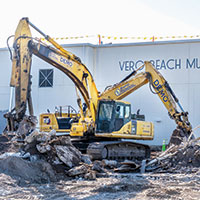
 Foundation sets a record with $2M museum donation
STORY BY JON PINE (Week of March 12, 2026)
Calling it a “once-in-a-generation opportunity,” the Indian River Community Foundation has donated $2 million – its largest single discretionary grant ever – to Vero Beach Museum of Art’s $126 million capital campaign. The museum is raising the money to fund a new, larger museum building set on an elevation amidst gardens and terraces.
While it’s not the largest capital campaign donation to the museum, which broke ground last November on its ambitious expansion project, it is a rare gift for the foundation, which until now has devoted more than 90 percent of its giving to organizations that serve vulnerable individuals and families.
“A lot of people think that a museum is just a place to hang art but that’s not true of Vero Beach Museum of Art,” said Rick McDermott, who founded the Community Foundation in 2008. “They do an awful lot of things for the community. They reach more than 30,000 kids each year.”
It is this fact that swayed the Community Foundation board of directors to say yes to such a large donation to an arts organization, McDermott said. “We here on the barrier island have our clubs and other stuff going on and we sometimes forget that this is a blue-collar town. For many, having access to a museum like this – and on some days for free – is a big deal.”
Initially, the board was considering donating only $1 million, according to foundation executive director Jeff Pickering. At that stage, museum Executive Director and CEO Brady Roberts talked with Pickering about possibly sponsoring a patio, walkway or meeting room. But none of those seemed right, Pickering said.
Then the conversation turned to the planned ceramics studios. The museum wanted $2 million for naming rights for the entire ceramics center.
“The initial feeling was, how can we choose to donate so much when there is so much need in the community?” Pickering said. But he asked Roberts to put together a presentation for foundation board members that showed all the elements of the planned expansion.
“We had a lot of discussion about that,” recalls board member Dawn Michael, who is also a member of the Foundation’s grants committee. “We talked for a long time, and a lot of good issues came up. Jeff is very organized and he explains things so easily.”
The foundation’s name on the ceramics center, close to the Buck Atrium and the lobby where visitors enter the museum, would be great exposure, Pickering told board members. And the ceramics center would serve everybody in the community, not just those from wealthy neighborhoods, he said.
“Our clients loved the community aspect of it more than the arts aspect, honestly,” Pickering said. “We can’t all be great painters, but we all grew up playing with Play-Doh. They liked the idea of creating a space where everybody could feel like they had a place to explore.”
In the end, everybody on the board agreed, Michael said, in part because the museum was already well along in the campaign, with more than $50 million donated by the museum’s board of trustees.
“The community foundation likes to put in some of the last dollars rather than the first dollars,” said Michael. “We were really comfortable that the build-out was going to happen. We also felt it was important for us to be part of it.”
The new ceramics center will feature a 1,000-square-foot studio, a brand-new kiln room and a new glazing room. The museum offered 29 ceramics classes last year, serving between 200 and 300 students, plus several dozen more during summer art camp ceramics sessions. Veterans can enroll in the classes for free. Ceramics classes typically sell out within hours of the opening of registration, said Suzanne Seldes, the museum’s deputy director.
“The investment from the Indian River Community Foundation comes at a critical moment in the campaign, serving as a catalyst to help us achieve our goal and amplifying VBMA’s commitment to broaden our reach in our community,” Roberts said.
As of March 9, the museum has raised $110 million of its $126 million capital campaign goal, with more than 38 gifts of $1 million or more from individuals and organizations.
“You’ll see some pretty dramatic changes to the campus in the coming months and years,” said Roberts. Programming will continue in the existing building through early 2027.
The site – situated to the west and south of the existing museum – will be elevated by 9 feet to place the new building outside the flood zone, while affording enhanced views of the lagoon and park through numerous windows. The building will be connected to the two-story hurricane-resistant bunker built in 2012 that is dedicated to art storage.
When the new building is completed in 2028, the existing 40-year-old facility will be demolished and that space will be replaced with landscaped gardens, featuring an elevated terrain that will lead to museum entrances on three sides. The main entrance, facing the ‘Under the Oaks’ section of Riverside Park, will open into a modern contemporary gallery.
“That creates multiple invitations to come into the museum. Now the museum becomes the natural thoroughfare in the park. We’re creating an acre and a half of green space in this project. It’s a design that’s made for the environment; it respects the environment and is part of it,” said Roberts.
“This will be a lovely, lovely place in Vero Beach. It’s just inviting; everything is about the invitation to the community to come and enjoy.”
That invitation is underscored by what will be free admission to the bright and spacious first floor, which features a modern and contemporary gallery, the education wing and studios, the Kids Art Zone, retail store, café and multiple terraces.
The first floor will also house administrative offices, a community room that flows to an outdoor event terrace facing the lagoon, and a 300-seat flex auditorium with seats that can be retracted for major events.
The second floor will provide 22,000 square feet of gallery space, double the current space, for the museum’s permanent collection and special exhibitions, with skylights bringing in diffused natural light.
To view the second-floor galleries, Roberts said, visitors have the option of attending on a free day, purchasing a ticket, or becoming a member.
Admission to the entire museum is free on the second Saturday of each month. On those days, docents will guide visitors on mini tours of the galleries, culminating with free activities in the art studios.
These free days will be expanded in the future to include performances, lectures, films and other activities that complement current exhibitions. More than 8,300 adults and children visited during free Saturdays last year, Seldes said.
The Indian River Community Foundation was started 18 years ago by McDermott and his wife, Laura. They raised $25,000 each from 52 founding members to launch the organization in 2008. Five years later, all 52 founders renewed their financial commitments, raising enough money to hire Pickering as executive director.
When Pickering came on board in January 2015, the foundation had a little over $20 million in assets. About halfway through the current fiscal year, that number had increased to $140 million, Pickering said.
There are two pools of funds, he said. One pool is donor-advised funds, sort of like a “charitable checkbook.” Clients make grants from these funds which they have donated, while the foundation manages the activity.
The other pool is unrestricted dollars matched by anonymous donors that the Foundation’s board and grants committee award to various local charities. This past year, for example, the foundation made a $1.5 million grant to Childcare Resources of Indian River to help pay for its new campus in downtown Vero Beach, Pickering said. It also gifted $1 million to Habitat for Humanity to help the organization renovate the former 26-unit Pennwood Motor Lodge on U.S. 1 in Wabasso to create affordable rental housing for low-income seniors.
The $2 million grant to VBMA came from this pool, Pickering said.
“People always say this community has the things it has because of the generosity of the people on the beach, which is true,” Pickering said. “But household giving across all income levels in the county is close to 6 percent of household income. Nationwide, it’s somewhere between 2 percent and 3 percent.
“That kind of generosity sets a ripple effect in motion through the community.”