


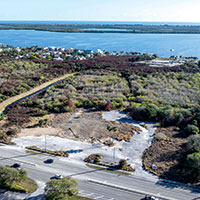
 Hale Groves sale: New eco-legacy for famed citrus site
STORY BY STEVEN M. THOMAS (Week of March 5, 2026)
Almost 80 years after Steve and Polly Hale opened a fruit stand on U.S. 1 that grew into a sprawling farm store and packing house, Indian River County has completed its purchase of the historic citrus property.
Located on the east side of the highway, a mile north of route 510, the original fruit stand was the start of what became the largest direct marketer of citrus in the world, shipping prime Indian River oranges and grapefruits around the globe for decades.
“The deal closed today,” the Hale family’s longtime broker Terry Torres told Vero Beach 32963 last Wednesday, Feb. 25.
The county paid $2.54 million for the 22-acre tract, which stretches east from the highway to within a few hundred feet of the Indian River Lagoon, as part of its Environmental Lands Acquisition Program, which is funded by a $50 million bond issue approved by voters in 2022.
The environmental and public recreational benefits of preserving the property are substantial according to the county, which has purchased an adjoining 11-acre property to the north and is considering purchasing another sizable chunk of land to the south.
The 11-acre property is called Durrance Place in county documents. The seller in that deal, Palm Bay Joan LLC, which bought the acreage for $250,000 in 2014, signed a contract on Sept. 10 that shows a purchase price of $1,260,000.
The contract prices were based on two independent professional appraisals for each property intended to establish their fair value.
County officials say the two parcels – possibly three – will be managed as a single conservation property that likely will include a restored salt marsh, which will help purify stormwater before it enters the lagoon, access to the lagoon for canoes and kayaks via an existing drainage canal, and a trail through existing upland pine and palm hammocks.
The Hale Groves property already has a parking lot, so the county will not have to disturb environmentally sensitive land to create a paved lot, restrooms or other entryway amenities, according to Beth Powell, director of the county’s Parks, Recreation and Conservation Department.
The ecological benefits loom even larger in light of how the property might otherwise have been used. The land along U.S. 1 where the fruit stand and later a large farm store once stood is zoned commercial, but most of the rest of the combined 33 acres is zoned multifamily residential, so the land would likely have been densely developed at some point, putting more pressure on the Lagoon.
“The family had a contingent contract with a developer who was paying more than $3 million for the property,” Torres said. “The contingency period expired before they secured all their approvals and they wanted to extend the contract – but the family said no.”
By that time, the property had been nominated for inclusion in ELAP, the county’s environmental lands purchase program, and Torres had begun negotiating a sale price.
“The family took less money in exchange for naming rights,” said Torres. “Stephen Hale was a very important person in the citrus industry. He built a big citrus empire and was known to all, and the remaining Hales are very proud of that.
“They are thrilled that the conservation property will bear his name and help preserve his legacy.”
The sales contract includes this ironclad clause: “Buyer acknowledges the Hale family’s longstanding contributions to Indian River County’s citrus industry and the historical significance of the Hale Packing House as a community fixture. In recognition of this heritage, Buyer agrees that the Hale family name will be incorporated into the public-facing identification of the property following acquisition, in a manner mutually agreed upon by Buyer and Seller, to honor and preserve the family’s legacy. This provision shall survive the closing of the transaction.”
Besides the thriving mail order business and extensive grove land, including groves at the U.S. 1 site, Steve and Polly Hale had three colorful retail outlets in Vero at the peak of Indian River citrus production.
In addition to the main farm store at 9251 U.S. 1, the family had a store at 580 U.S. 1, between 4th Street and 8th Street where a Dollar General store is now, and another retail outlet at 615 Beachland Boulevard, where VB Home interior design does business today.
“It had a drive-thru window where you could stop to pick up fruit or fresh juice,” Torres said of the island’s long-gone local citrus outlet.
By that time, the company’s mailing list had grown to include millions of names, according to a 2014 post on the Hale Groves website.
World War II Navy veteran Stephen Hale and his wife Polly arrived in Vero Beach with their two children in 1947, in part because Hale “wanted to raise his family in sunshine,” according to the Hale Groves website.
That worked out to perfection as the couple had two more children, ending up with two boys and two girls, and saw their business bloom.
“The children eventually became involved in the business, beginning at an early age,” according to the website. “Steve III and Dexter bagged fruit for customers from the time they were 7 or 8. Susan and Marianne began working behind the counter when they were about 10 years old. Susan would ask where a customer came from and then say, ‘Oh, that’s my favorite city.’ They would get letters from customers who remembered her.”
There is mystery as well as important local history at the now county-owned property.
“There was path on the north side of the store that led back to the groves and Steve would take customers down that path to see the orange and grapefruit trees and maybe pick a piece of fruit,” Torres said. “At some point he buried a time capsule near that path and no one in the family knows what is in it.
“Susan Hale still lives in Vero and is the family representative. She and I have searched for it with metal detectors and hand digging, but we haven’t found it. Hopefully the county will unearth it.”
After Steve Hale’s death in 2005 at age 86, the family sold the fruit shipping business to Indrio Brands, but retained ownership of the property at 9251 U.S. 1.
The charming old grove store stayed busy for many years after the sale but eventually succumbed to a changing market for fresh fruit and the decline of the local citrus industry brought on by greening.
The store closed in 2017, and Torres offered the building and land for sale or lease for the next five years, with the cavernous structure looking shabbier each year, succumbing to weather and time. He had a lot of lookers, but no one ever pulled the trigger and the former store and packing house was demolished in 2021, leaving just the land for sale.
Torres said a number of national homebuilders tried to acquire the property, with one eventually putting it under contract.
When county voters approved the $50 million bond issue in 2022 for purchasing environmentally sensitive land, the offering was split into two tranches. The first bond was issued in June 2024 for $25 million, which must be spent by June 2027. When that bond is wrapped up, another $25 million will be offered.
The county has an egalitarian system in place for property nominations.
Land can be nominated for purchase by county staff, environmental groups, individual landowners or any member of the public. Both the Hale site and the Durrance site were nominated for ELAP by a neighbor, Chrissy Trujillo, Powell said.
A panel composed of professionals with respective backgrounds in natural resources, planning, engineering, real estate and finance, plus volunteers from all five county districts meet monthly to review and rank nominated parcels.
To date, 87 properties ranging from small neighborhood plots to large tracts of land in the western part of the county have been nominated.
Of those, 83 were eligible for the program, 33 were owned by willing sellers, and 19 have been identified as top prospects for ELAP, classified at Tier 1 properties.
The county, which will only negotiate with willing sellers, has reached agreements to purchase five properties so far and closed on three.
“The citizens of Indian River County should take pride in the legacy they have chosen to leave for future generations,” said County Commission Chair Deryl Loar.