


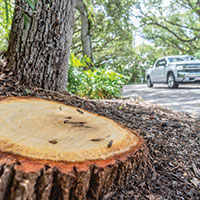
 Beloved oak trees cut down on island in name of safety
STORY BY PIETER VANBENNEKOM (Week of May 21, 2026)
Island residents are deeply attached to their stately oak trees, which are one of the island’s prized “Old Florida” features and have given their name to developments along A1A such as Sea Oaks, Sea Forest and Robles del Mar, but that abiding love of trees collided this spring with Indian River Shores regulations intended to protect life and property.
Florida Power & Light contractors go up and down island streets at least once a year before hurricane season to trim back tree branches, and occasionally cut down an entire tree, to prevent power lines from being downed by falling limbs or trees during storms, and resident “tree huggers” often think those crews go too far in cutting back the dark green foliage.
The latest round of cutting was done at the behest of municipal authorities at the Town of Indian River Shores, which sent warning letters to two classic island subdivisions – Baytree and Indian Trails –informing residents and community associations that wider, higher paths needed to be cleared through the oak and palm canopies to guarantee access for firetrucks and ambulances.
The two developments were told they were in “noncompliance” with the town access ordinance and the Florida Fire Prevention Code, said Jim Harpring, Indian River Shores town manager. Specifically, access had to be guaranteed for vehicles as tall as 13 feet, 6 inches, and the left-to-right clearance for emergency equipment had to be at least 20 feet wide.
The notices provoked unhappiness and grumbling from residents, but both developments are taking measures to bring their public access roads up to the required standards and Harpring said he is pleased with the level of compliance. If the developments had not complied, they would have faced the possibility of daily fines that would accumulate until action was taken.
“I believe residents want our fire rescue apparatus and services to have unfettered access to their communities,” Harpring said.
It is not entirely clear what led the town to issue its warning letters as there are different versions as to the origin of the initiative. Harpring said the town’s Public Safety Department simply “conducts periodic reviews in the community to ensure fire apparatus can access roads.”
But one Baytree resident who asked not to be identified says he recalled an incident several months ago when an ambulance was able to reach a home where a resident was in distress only with great difficulty because of encroaching tree limbs and foliage. The vehicle also had a hard time turning around and heading back out to the exit.
Katharine Papadopoulos, president of the condo owners association in Baytree, said she believes the inspections were triggered when the town recently acquired and inaugurated, with a lot of fanfare, a new, taller fire truck with a ladder that, even when folded down, has a greater height than the town’s older fire trucks.
Whatever the reason – it may be a combination of all three – Papadopoulos said Baytree’s condo association board of directors met within a week of receiving the town’s warning letter and instructed the association’s landscaping service, Distinctive Landscaping Management, owned by certified arborist Raymond Cooper, to make a plan and do what was necessary to comply with the town’s requirements.
As a result, 10 of the community’s approximately 350 live oak trees were removed and dozens of others had their overhanging branches trimmed back substantially, mostly on the west side of the development, which straddles A1A.
Papadopoulos said the town’s authorities, including the fire marshal and the public safety and operations departments, have been “very easy to work with and have been excellent partners” in trying to guarantee the safety of the residents.
“Some of our residents were taken aback and quite sad,” Papadopoulos admitted. “All of our residents value the trees that create such a beautiful canopy. But while we love our live oaks, the safety of our residents comes first. It’s safety above all, and we complied quickly because we realize this can save our lives.”
Similar sentiments were expressed at nearby Indian Trails, less than a mile south of Baytree, where one snowbird resident said she had noticed widespread cutting of trees the day before she left for the summer up north.
“Too bad,” she said of the live oak trees being cut down. “They are so pretty and provide great shade.”
Another Indian River Trails resident, who asked not to be named, said that at the Board of Directors meeting where the need for tree trimming was announced, one resident was quite upset that three palm trees were removed from around his property.
“He was not happy about it,” she said. “We believe our beautiful canopy of trees enhances the value of our properties, so this is not good, but I guess that for safety reasons we had to do it.”
The gated waterfront community of Baytree is comprised of 108 units including condos and villas. Designed by island architect Clem Schaub and built 42 years ago, the development won awards for its cluster concept, which involved building residences around existing oak trees, most of which were preserved, becoming an essential part of the community.
Indian Trails promotional literature says the community is “nestled among oak trees” and includes homes in charming Old Forida, New England farmhouse and Key West architectural styles.