


 New ERs expected to relieve ambulance pile-ups, boost revenues
STORY BY LISA ZAHNER (Week of October 29, 2026)
If a third hospital gets county approval to build on 66th Avenue, and Cleveland Clinic completes its emergency care expansion plans on schedule, Indian River County residents will have six different emergency rooms to choose from by 2028.
Four of the six would be what are known as Free-Standing Emergency Departments, or FSEDs. With no FSEDs slated to be built on the barrier island, the greatest benefit to island residents would be the funneling of west Vero and south county ambulance traffic away from Cleveland Clinic Indian River Hospital's main Vero Beach campus emergency department.
On television and in the movies, the moment an ambulance rolls up to an ER, paramedics wheel the patient in, or doctors rush out to meet the ambulance as the back doors swing open. The patient is taken inside immediately, and the ambulance rolls off to the next call.
But here, local paramedics have long complained about having their rigs "stacked" outside the ER.
Public records from Indian River County Fire-Rescue show that from January 2024 to December 2025, county ambulances were delayed, waiting for the Cleveland Clinic ER to accept transported patients, a total of 1,350 times. That's an average of about twice per day over the two-year period. Only delays of five minutes or longer were logged, so delays shorter than five minutes are not included in the 1,350 number. Indian River Shores Public Safety ambulance delays are also not included in the county's numbers.
Ambulance drivers must log the delays with dispatch because getting stuck at the hospital pulls the ambulance away from its geographic zone around its fire station. If another call comes in for that ambulance's home station before its crew is clear of the hospital ER and back in service, an ambulance from a different station across town must respond. This can result in ambulances crisscrossing the county with lights and sirens on, slower response times, extra miles on emergency vehicles, additional fuel expense and added stress on fire-rescue personnel.
Most of the delays logged ranged from eight to 16 minutes, but 208 times the delay exceeded 20 minutes, 52 times the delay exceeded 30 minutes, and six times the ambulance idled outside the ER for more than one hour before the patient could get a bed.
The worst months in terms of "stacked" ambulances are December through March, when the island population swells with snowbirds. The most delay-prone part of day to be transported by ambulance is 2 p.m. to 8 p.m.
Delays should be reduced as Cleveland Clinic completes a $20 million emergency department renovation, increasing capacity from 67 patient stations or beds to 105. Vero's hospital sees more than 60,000 ER visits per year, making it the busiest ER in Cleveland Clinic's Florida system, according to the hospital.
But having a total of six emergency departments by 2028 – including the one built as the first phase of the proposed 66th Avenue hospital – would help patients transported by ambulance get seen by a doctor sooner, likely leading to improved outcomes for many people. It would also make more efficient use of a limited supply of ambulances and paramedics countywide, keeping each rescue unit closer to its home station.
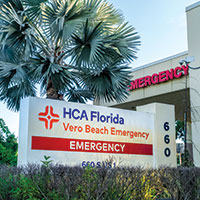
HCA Florida Lawnwood Hospital established the county's first FSED, which is open 24/7 on U.S. 1 a few blocks north of Oslo Road as an extension of Lawnwood's Level 1 trauma center in Fort Pierce. Without that 12-bed, $10 million facility accepting ambulances since 2019, the ambulance delay numbers from 2024 and 2025 would likely be worse.
"Our HCA Florida Vero Beach Emergency Department has been busy since opening, and we continue to see strong demand for emergency services in the community," HCA spokesman Alex Hagan said. "We treat both walk-in patients and those arriving by ambulance. We're pleased to provide convenient access to emergency care for Indian River County residents."
Since opening the U.S. facility, HCA has continued to invest heavily in FSEDs, and in February 2025 announced a $70 million, three-FSED project on the west coast of Florida.
FSEDs are big business across the country and especially in Florida, as they create a lucrative pipeline for bringing new patients into the operating hospital's system of providers.
Free-standing emergency departments can be confusing – and costly. Patients might feel like they are walking into a large-scale urgent care, but buyer beware – a visit to an FSED costs the same as going to an emergency department located inside a hospital – though hopefully without the long wait times.
For minor complaints that don't warrant a big ER copay, HCA Lawnwood's sister company MD Now has urgent care facilities on U.S. 1 and in the Miracle Mile area. The facilities offer commonly prescribed medications on site to save patients the wait at Walgreens or CVS while sick or injured.
While marketed as a way to serve residents closer to their homes, free-standing emergency departments are also an opportunity for hospitals to make a great first impression and increase their market share.
Besides expanding the emergency department at the hospital, Cleveland Clinic plans to open two new FSEDs in the next two years – one in south county and one in Sebastian.
The south county location will be on the southwest corner of Oslo Road and 27th Avenue SW, behind the Dollar Tree store. The Sebastian facility will be built on vacant land between the east- and westbound spans of route 512, at 200 to 203 Sebastian Boulevard, just east of Wimbrow Drive.
"Building on the recent expansion of our main emergency department, these facilities will bring 24/7 emergency care closer to where people live, help reduce travel and transport times and improve access to Cleveland Clinic services throughout the county," said Dr. Richard Rothman, vice president and chief medical officer at Cleveland Clinic Indian River Hospital.
In the early 2000s, there were only about 50 FSEDs nationwide. But as states like Florida phased-out Certificate of Need requirements, barriers to opening FSEDs when hospitals think it makes commercial or competitive sense disappeared. Wolf Media's healthcare trade publication reported in April that the number of FSEDs had grown from 566 in 2016 to an estimated 850 as of this spring – with 30 of those developed in South Florida.
According to Grandview Research, "The U.S. freestanding emergency department (FSEDs) market size was valued at $17.5 billion in 2025 and is projected to grow from $18.5 billion in 2026 to $29.6 billion by 2033.
"This growth is driven by the increasing demand for rapid emergency care, increasing patient preference for convenient healthcare access, and rising emergency department overcrowding at hospitals," the Grandview report said. "Increasing incidences of trauma, cardiovascular emergencies, respiratory conditions, and other acute illnesses are further driving patient visits to FSEDs, which offer 24/7 emergency services with shorter waiting times and advanced diagnostic capabilities."
Free-standing emergency facilities can be independent but are typically connected to a hospital a short drive away. That way, if patients need to be admitted or need emergency surgery or intensive care, they can be transported to the operating hospital's main campus.
As a result, the owner-hospital's cardiologists, neurologists, orthopedic surgeons, oncologists, rheumatologists and other specialists get new patients from FSED clientele. The FSED/hospital nexus is also a way to sell imaging and laboratory services at the FSED or in the main hospital.
Patients who turn up in the FSED because they don't have a primary care physician are another avenue for new business, as they typically are referred to a doctor within the hospital system for follow-up care, bloodwork, medication maintenance or to catch up preventative screenings.
When Cleveland Clinic's planned Oslo Road and Sebastian FSEDs open, staff there will offer "real-time discharge follow-up appointments" so patients leave with a concrete plan to see a Cleveland Clinic doctor," Rothman said. "Follow-ups at the time of discharge and facilitating access to the appropriate physicians nearest to the patient's home are aspects of care we are very focused on to improve continuity of care while reducing travel time for patients."
Because free-standing emergency departments are major revenue generators, hospitals search for locations to open FSEDs where younger families with private health insurance live, since those patients are the most lucrative. Private insurance reimburses hospitals for services at much higher rates than Medicare or Medicaid.
Cleveland Clinic's planned FSEDs on Oslo Road and in the Sebastian Highlands will provide 24/7 emergency care for walk-ins and ambulances in areas of the county with a high concentration of people younger than 65, who are still in the workforce and most likely to have children.
Cleveland Clinic also has an urgent care centers at Pointe West and in Sebastian, for less serious injuries or illnesses.